Aframomum melegueta (Grains of paradise) is not Alligator pepper part 2
“I put a few between my teeth and crunched. They cracked like coriander releasing a billowing aroma, and then a slowly intensifying heat, like pepper at the back of my mouth. The taste changes in a second. The heat lingered. But the spice flavor was pleasantly tempered, ripe with flavors reminiscent of jasmine, hazelnut, butter and citrus, and with the kind of oiliness you get from nuts. They were entirely different from black peppercorns and in my mind, incomparably better.”
Amanda Hesser, New York times, 2000
Can you make a Guess what all those Paean is for?
It is for……………………..Aframomum melegueta (Grains of paradise).
Let’s know a little about Aframomum melegueta (A. melegueta)
Let’s know a little about Aframomum melegueta (A. melegueta)
A.melegueta is a known name when listing the medicinal, aromatic tropical plants that exist. This is not only because of its various uses but also the historical value attached to it.
The first known reference to the plant dates from 1214 A.D., there were remarks that physicians in places as far apart as the Frankish Court at Nicosia, Rome, Lyons and Wales included this plant in medical prescriptions. Queen Elizabeth I of England was also noted to flavour her Beer with it (Harten, 1970).
Around the 14th-15th Century, Pliny mentioned it to be African pepper and it was later referred to as Grains of Paradise when it became a popular substitute for Black pepper in Europe.
Around the 14th-15th Century, Pliny mentioned it to be African pepper and it was later referred to as Grains of Paradise when it became a popular substitute for Black pepper in Europe.

king Afonso_V of Portugal
(public domain image)
(public domain image)
In 1469, it was given another name; Malagueta (a Portuguese word which literally means ‘chilli pepper’) and gained more popularity as it was included in the trade by a Portuguese merchant and explorer from Lisbon; Fernao Gomes, in the Gulf of Guinea following the permission of King Afonso V of Portugal. Around these centuries, Menagier de Paris(French medieval book on a woman’s proper behaviour in marriage and running a household since 1393) recommended it for improving wine that smells stale, also, the present region now known as Liberia was named ‘Grains coast’ (adapted fromGrains of paradise) because its seeds were major export item in the region at that period.
The first scientific puplication on this plant was done by Karl Moritz Schumann on the 4th October, 1904. A.melegueta is also commonly called Guinea grains and erroneously Alligator pepper!
Wait a minute……Is this Alligator pepper or A. melegueta???
Characteristics of A.melegueta
A.melegueta is a perennial deciduous herb native to the tropics and grows at the swampy habitats of the West Africa coast. It belongs to the Ginger family (Zingiberaceae). It possesses tufted leafy stem that can be up to 1.5m high. The leaves are simple, alternate and lanceolate. The matured leaves can grow as long as 40cm in length and 12cm-15cm wide. It produces purple coloured flowers which develops into pods that can be as long as 8cm and about 3cm wide. This pod contains numerous reddish-brown seeds (can be as many as 300 seeds in one pod). The sharp and peppery taste of the seeds is caused by the aromatic ketones; 6-paradol, 6-gingerol and 6-shogaol present in it (Sugita et al, 2013). The fruits are fleshy, indehiscent and produce spikes. It cannot survive temperatures below 1°C.
A.melegueta is a perennial deciduous herb native to the tropics and grows at the swampy habitats of the West Africa coast. It belongs to the Ginger family (Zingiberaceae). It possesses tufted leafy stem that can be up to 1.5m high. The leaves are simple, alternate and lanceolate. The matured leaves can grow as long as 40cm in length and 12cm-15cm wide. It produces purple coloured flowers which develops into pods that can be as long as 8cm and about 3cm wide. This pod contains numerous reddish-brown seeds (can be as many as 300 seeds in one pod). The sharp and peppery taste of the seeds is caused by the aromatic ketones; 6-paradol, 6-gingerol and 6-shogaol present in it (Sugita et al, 2013). The fruits are fleshy, indehiscent and produce spikes. It cannot survive temperatures below 1°C.


Taxonomic classification
Kingdom: Plantae
Division: Magnoliophyta
Class: Liliopsida
Order: Zingiberales
Family: Zingiberaceae
Genus: Aframomum
Species: Aframomum melegueta
Kingdom: Plantae
Division: Magnoliophyta
Class: Liliopsida
Order: Zingiberales
Family: Zingiberaceae
Genus: Aframomum
Species: Aframomum melegueta
Synonyms of A. melegueta
- Aframomum grana-paradisi (L.) K.Schum.
- Aframomum meleguetella K.Schum.
- Alexis grandiflora (Sm.) Salisb.
- Alpinia grana-paradisi (L.) Moon
- Amomum elatum Salisb. [Illegitimate]
- Amomum grana-paradisi L.
- Amomum grandiflorum Sm.
- Amomum melegueta Roscoe [Illegitimate]
- Amomum melegueta var. violacea Ridl.
- Cardamomum grana-paradisi (L.) Kuntze
- Cardamomum grandiflorum (Sm.) Kuntze
- Torymenes officinalis Salisb. [Illegitimate]
Common names of A.melegueta

Distribution of A. melegueta
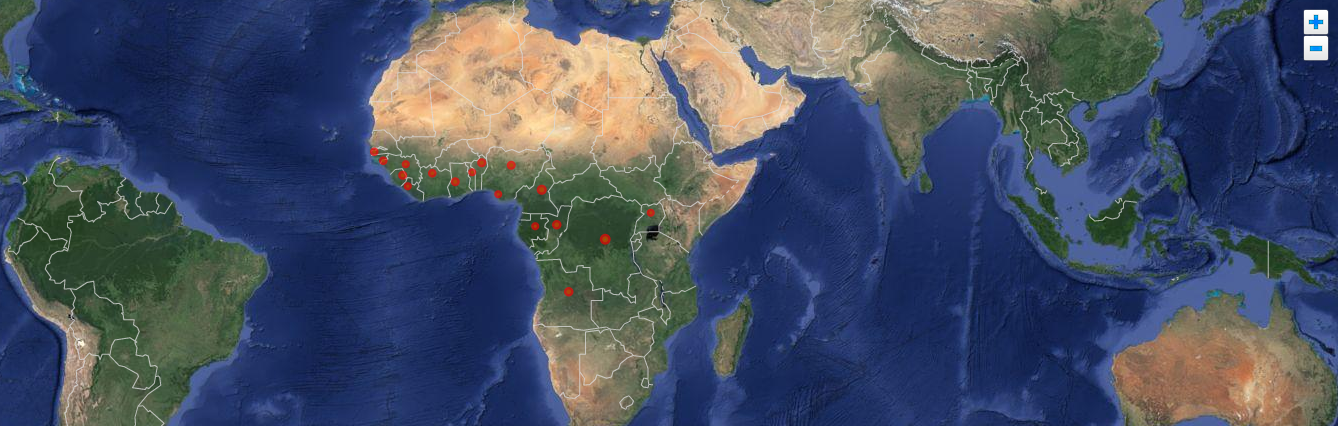
It is native to the West African region. The distribution map below shows that it can be found in Nigeria, Uganda, Angola,Benin, The Gambia, Ghana, Guinea, Cote d’Ivoire(Ivory Coast), Liberia,, Sierra Leone, Togo, Cameroon,Congo, Gabon, Gulf of Guinea Is., Democratic Republic of the Congo (Zaire), Guinea-Bissau but widely cultivated in various parts of other tropical Africa, South America and several other places.
It is native to the West African region. The distribution map below shows that it can be found in Nigeria, Uganda, Angola,Benin, The Gambia, Ghana, Guinea, Cote d’Ivoire(Ivory Coast), Liberia,, Sierra Leone, Togo, Cameroon,Congo, Gabon, Gulf of Guinea Is., Democratic Republic of the Congo (Zaire), Guinea-Bissau but widely cultivated in various parts of other tropical Africa, South America and several other places.
A. melegueta and its Medicinal uses
Medicinal uses of A.melegueta ranges from;
- anti-inflammatory capabilty;
- antimicrobial activities ;
- Preventing/healing dental problem, Asthma and Body weakness ;
- increasing whole-body energy expenditure by its oral ingestion
- protective capacity on crops such as Zea mays (Maize) and more medicinal uses are being discovered on daily basis
A.melegueta and Culinary uses
The heat is what has kept it alive in people’s minds. It can be mixed with coriander, cinnamon, dried chilies and cloves as a condiment for grilled lamb, chicken, fish, pumpkin and okra, or added to soups, stews and pickling mixtures. They can also be found in ‘raz al hanout’, the spice mixture of Morocco (Hesser, 2000).
The heat is what has kept it alive in people’s minds. It can be mixed with coriander, cinnamon, dried chilies and cloves as a condiment for grilled lamb, chicken, fish, pumpkin and okra, or added to soups, stews and pickling mixtures. They can also be found in ‘raz al hanout’, the spice mixture of Morocco (Hesser, 2000).
”Yummy’‘, nothing tastes better than its flavour around your meals……you might want to give it a try today!!!
A.melegueta and Culture
When a baby is born in Africa, for instance, in the Yoruba culture(Nigeria), a small amount is given to them to taste, this is done minutes after they are born. It is said to be a welcoming process for the baby. It is also used as a traditional wedding gift in the same Yoruba culture. In addition to this, A.melegueta together with kola nut is served to guests in the Eastern part of Nigeria. When chewed together, the hot spicy taste enhances or reduces the bitter taste from the kola nut. A.melegueta is used for divination and ordeal to determine who is guilty of an offence among the Efik people (primarily Eastern part of Nigeria). It is also used for religious (voodoo) rites at the Caribbean Islands.
One of the myths as regards this seed is that it prevents accident when swallowed and also reduce the state of drunkenness ( you might give this myth a try when you feel tipsyBUT NOT with Accident!).
One of the myths as regards this seed is that it prevents accident when swallowed and also reduce the state of drunkenness ( you might give this myth a try when you feel tipsyBUT NOT with Accident!).
Here, is the BIG BOOM……………….
A.melegueta is NOT ALLIGATOR PEPPER
A.melegueta is NOT ALLIGATOR PEPPER
The seed of Alligator pepper is from A. danielli, A. citratum or A. exscapum. The spice grows wild in countries like Nigeria, Ghana, Guinea and Liberia. The English name –Alligator pepper becomes very obvious when the pod is open and the seeds are shown, the seeds have a papery skin enclosing them and the bumps of the seeds within this skin looks like that of an alligator’s back. The alligator pepper is sold as an entire pod which contains the seed unlike the grains of paradise which is sold as only seeds. It is highly aromatic than that of A.melegueta (Grains of paradise) seeds.


It is worthy to note that this same plant generally known as Alligator pepper by a Lay-man in many countries (i.e Nigeria) is also been refered to as A.melegueta ( Grains of Paradise) by the botanical researchers in that region.
The Ultimate search for what is correct!
After thorough investigation using different search engines available, it was discovered that larger number of Researchers(all around the globe) that have worked on A. meleguetaused Alligator pepper as one of its common names while very few others tried to differentiate them.
The question is: How do we know for sure which seeds of genus Aframomum was used by these Researchers; A. melegueta or Alligator pepper(from A. danielli, A. citratumor A. exscapum)? This crucial question points to the fact that there is need for comprehensive research that will succintly clarify the differences among these species of Aframomum as it appears that most of the focus as been on the uses of these plants.
……..while the hunt for the right seed-identity of what Queen Elizabeth I of England used to flavour her Beer continues……please know that the English common names ofA.melegueta are Grains of paradise, Guinea grains BUT not Alligator pepper!!!
You might also want to read my previous post on these species.
References
All images, video and Map were created by the Blogger.
Betumiblog (2013). Grains of Paradise or Alligator Pepper?
URL: http://betumiblog.blogspot.co.uk/2013/01/grains-of-paradise-or-alligator-pepper.html. [15 October 2013]
URL: http://betumiblog.blogspot.co.uk/2013/01/grains-of-paradise-or-alligator-pepper.html. [15 October 2013]
Echo I.A., Osuagwu A.N., Agbor R.B., Okpako E.C, and Ekanem B.E. (2012)
Phytochemical Composition of Aframomum melegueta and Piper guineense Seeds. World Journal of Applied Environmental Chemistry. 2(1): 17-21
Phytochemical Composition of Aframomum melegueta and Piper guineense Seeds. World Journal of Applied Environmental Chemistry. 2(1): 17-21
Harten A.M. (1970). Melegueta pepper. Economic Botany. 24(2): 208-216.
Hesser A. (2013). What Peppercorns Only Dream of Being. URL: http://www.nytimes.com/2000/05/03/dining/what-peppercorns-only-dream-of-being.html?pagewanted=all&src=pm [23 October 2013]
IPNI (2005). Plant name details. URL: http://www.ipni.org/ipni/idPlantNameSearch.do?id=871877-1. [1 November 2013]
Liberian Forum.com (2006). America colonization society. URL: http://liberianforum.com/liberianfacts.htm. [1st January, 2014].
Multilingual Multiscript plant Name database(2001). Sorting Aframomum names. http://www.plantnames.unimelb.edu.au/Sorting/Aframomum.html#melegueta. [ 2nd January, 2013].
Odugbemi T. (2008). A textbook of Medicinal plants in Nigeria. Lagos: Tolu Odugbemi.
Sugita J, Yoneshiro T, Hatano T, Aita S, Ikemoto T, Uchiwa H, Iwanaga T, Kameya T, Kawai Y and Saito M.( 2013). Grains of paradise (Aframomum melegueta) extract activates brown adipose tissue and increases whole-body energy expenditure in men. British Journal of Nutrition. 110(4): 733-738
The Plant List(2010). Aframomum melegueta K.Schum. Version 1. URL: http://www.theplantlist.org/tpl/record/kew-218399. [1st November, 2013].
Ukeh D.A., Umoetok S.B.; Bowman A.S., Mordue A.J., Pickett J.A., and Birkett M.A. (2011). Alligator pepper; Aframomum melegueta, and Ginger;Zingiber officinale, reduce stored maize infestation by the maize weevil, Sitophilus zeamais in traditional African granaries. Crop protection. 32 : 99-103.
Ukeh D.A., Umoetok S.B.; Bowman A.S., Mordue A.J., Pickett J.A., and Birkett M.A. (2011). Alligator pepper; Aframomum melegueta, and Ginger;Zingiber officinale, reduce stored maize infestation by the maize weevil, Sitophilus zeamais in traditional African granaries. Crop protection. 32 : 99-103.
The Sleuth Journal(2013). An herb for Thought: Alligator pepper . URL: http://www.thesleuthjournal.com/herb-thought-alligator-pepper/. [12th December, 2013].
Wikipedia (2013). Alligator pepper. URL: http://en.wikipedia.org/wiki/Alligator_pepper. [21 October 2013].
Comments
Post a Comment