Forest Plants in Kenya Grown for Traditional Medicines
Kakamega Forest in Western Kenya one of country's last remaining stands


Last updated on: November 24, 2009 2:50 AM
Kakamega Forest is one of Kenya's last remaining virgin forests, containing many trees and plants that have curative properties. To protect these medicinal plants from harm, local farmers are being encouraged to grow them instead of harvesting the plants from the forest. The farmers also win by getting good money for their crops.
This is an increasingly common sight in Kenya, graveyards of what once were mighty forests, teeming with life. The Kakamega Forest in Western Kenya is one of the country's last remaining stands.
Plants in the forest are being damaged or killed because people harvest them for traditional medicines.
So, to save Kakamega Forest, an international research group has transferred two popular plants out of the forest and into the hands of farmers such as Mary Shimuli.
Shimuli grows a half-acre's worth of Ocimum kilimandscharicum and harvests the plant every six months. She says that, besides saving the forest, her harvests bring her family a better income. "I used to go to the forest for firewood, but I was afraid of being arrested. After I realized that the project is fruitful for me, I stopped going to the forest. I managed to buy three cows," she said.
Shimuli and other farmers bring what they harvest to a nearby factory owned and operated the community and supported by African Insect Science for Food and Health, or ICIPE. The ocimum is weighed, dried, then processed.
The oil extracted is used to manufacture Naturub, a balm and an ointment used to treat flu, cold, chest congestion, aches, pain and insect bites. The products have been certified and approved by the government.
The products are sent to the capital Nairobi, where they are packaged. They are sold in 80 outlets, including Kenya's major supermarkets, and are gaining in popularity, says Frederick Nduguli, a marketing consultant with ICIPE. "Natural products have been used since time immemorial, so they are well-known in the marketplace as natural products but they have always been consumed in their raw form. Our role as ICIPE has been to add value to these natural products," he said.
He says that, by commercializing ocimum, the plant is used more efficiently, it is available to more people, and Kakamega Forest is conserved.
Wilber Lwande explains the science behind ocimum, "We found that the major constituent of this plant is a compound called camphor. Camphor has been shown scientifically to be having medicinal properties. Mainly it relieves pain and also it is an anti-microbial - it kills germs. Camphor has been used in various medicinal preparations such as Vicks, Robb, Deep Heat, but they use synthetic camphor," he said. "So we thought that this was a good source of medicinal product which would actually be of natural origin."
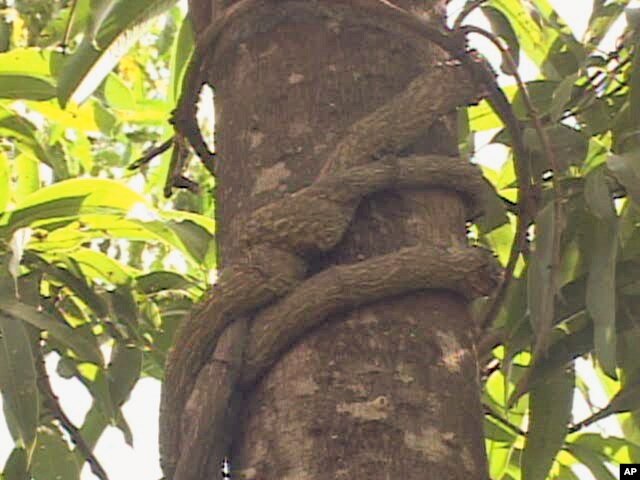
Another medicinal plant found in Kakamega Forest is mondia, a vine that has for centuries been used as a flavoring agent and medicine. Farmers are now starting to cultivate mondia.
A community group processes the root to produce a powder branded Mondia Tonic. It is said to be an antioxidant, a revitalizer, and a cure for hangovers.
This is an increasingly common sight in Kenya, graveyards of what once were mighty forests, teeming with life. The Kakamega Forest in Western Kenya is one of the country's last remaining stands.
Plants in the forest are being damaged or killed because people harvest them for traditional medicines.
So, to save Kakamega Forest, an international research group has transferred two popular plants out of the forest and into the hands of farmers such as Mary Shimuli.
Shimuli grows a half-acre's worth of Ocimum kilimandscharicum and harvests the plant every six months. She says that, besides saving the forest, her harvests bring her family a better income. "I used to go to the forest for firewood, but I was afraid of being arrested. After I realized that the project is fruitful for me, I stopped going to the forest. I managed to buy three cows," she said.
Shimuli and other farmers bring what they harvest to a nearby factory owned and operated the community and supported by African Insect Science for Food and Health, or ICIPE. The ocimum is weighed, dried, then processed.
The oil extracted is used to manufacture Naturub, a balm and an ointment used to treat flu, cold, chest congestion, aches, pain and insect bites. The products have been certified and approved by the government.
The products are sent to the capital Nairobi, where they are packaged. They are sold in 80 outlets, including Kenya's major supermarkets, and are gaining in popularity, says Frederick Nduguli, a marketing consultant with ICIPE. "Natural products have been used since time immemorial, so they are well-known in the marketplace as natural products but they have always been consumed in their raw form. Our role as ICIPE has been to add value to these natural products," he said.
He says that, by commercializing ocimum, the plant is used more efficiently, it is available to more people, and Kakamega Forest is conserved.
Wilber Lwande explains the science behind ocimum, "We found that the major constituent of this plant is a compound called camphor. Camphor has been shown scientifically to be having medicinal properties. Mainly it relieves pain and also it is an anti-microbial - it kills germs. Camphor has been used in various medicinal preparations such as Vicks, Robb, Deep Heat, but they use synthetic camphor," he said. "So we thought that this was a good source of medicinal product which would actually be of natural origin."
Another medicinal plant found in Kakamega Forest is mondia, a vine that has for centuries been used as a flavoring agent and medicine. Farmers are now starting to cultivate mondia.
A community group processes the root to produce a powder branded Mondia Tonic. It is said to be an antioxidant, a revitalizer, and a cure for hangovers.
Comments
Post a Comment