Medical cannabis company donates $1 million to explore plant’s healing potential

Herb Dhaliwal, Chairman of National Green Biomed with Julio Montaner, M-J Milloy and Claudette Cardinal. Photo: Martin Dee, UBC
Medical marijuana producer National Green Biomed Ltd. has committed $1 million to the University of British Columbia to allow researchers to study the therapeutic effects of cannabis. The company has made an application and is awaiting approval from Health Canada to produce and sell medical marijuana.
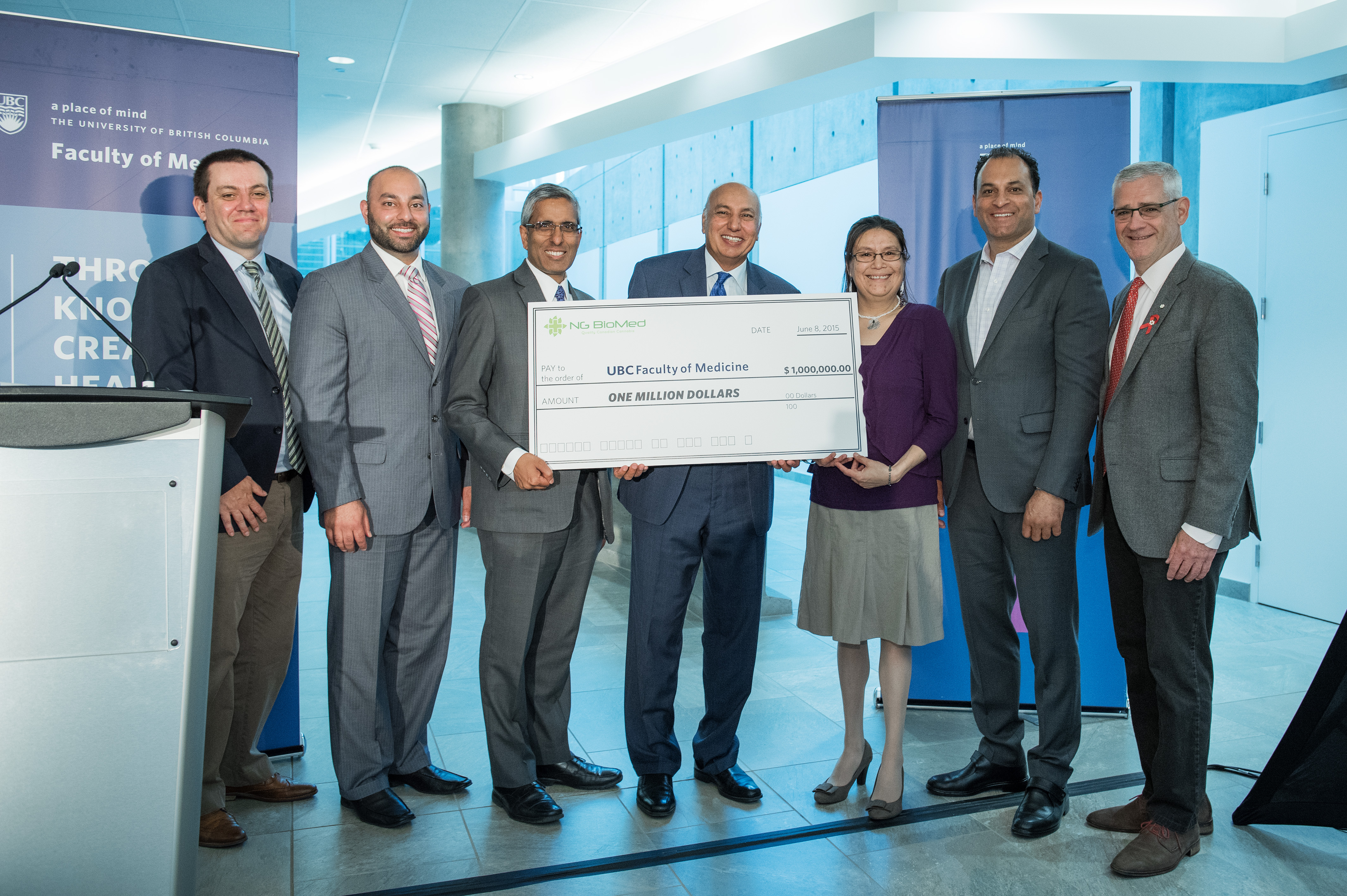
Click to enlarge. Photo: Martin Dee
The contribution will support research by assistant professor of medicine M-J Milloy, who is studying marijuana’s potential to treat HIV, and alleviate pain and nausea caused by acute illness and medications used to combat HIV and AIDS.
Milloy, an infectious disease epidemiologist with the UBC Division of AIDS and the British Columbia Centre for Excellence in HIV/AIDS, was the lead investigator on a study published in March that found that HIV positive people who used marijuana at least daily had less than half the concentration of the HIV virus in their blood compared to people who rarely or never consumed cannabis. The study, published in Drug and Alcohol Review, was the first epidemiological evidence from human studies that shows cannabis interacts with the underlying mechanism of HIV disease – not just its symptoms.

M-J Milloy
“Because cannabis has been seen primarily as a recreational drug, its medicinal implications have been much overlooked in formal research circles,” said National Green Chairman Herb Dhaliwal, a former MP and federal cabinet minister from Vancouver. “Now, thanks to evolving attitudes, it’s time for the science to catch up. We believe our partnership will help UBC create a standing research program into the possible therapeutic benefits of medical cannabis.”
Milloy examines barriers to effective HIV and AIDS treatment, such as homelessness and incarceration, and how addiction treatment can facilitate adherence to HIV therapy. He is leading a U.S. National Institutes of Health study involving about 1,000 people living with HIV/AIDS who also use illicit drugs. He also participated in the scientific evaluation of Insite, Vancouver’s supervised injection facility, and helped demonstrate how it reduced the number of overdose deaths in the Downtown Eastside.
“We have long heard from our patients that they perceive that they obtain health benefits from cannabis use,” said Dr. Julio Montaner, head of the UBC Division of AIDS and director of the British Columbia Centre for Excellence in HIV/AIDS. “This contribution will allow us to begin to rigorously assess whether these benefits are truly real.”
The partnership resulting from National Green’s contribution forms part of UBC’s start an evolution campaign, the most ambitious fundraising and alumni engagement campaign in Canadian history.
“One of the great virtues of universities is their willingness and freedom to look for answers in unconventional places,” said Arvind Gupta, UBC’s president and vice chancellor. “Canadian attitudes on the issue of marijuana’s legality and availability are still very much in flux. But if marijuana can help reduce pain or nausea, or even treat disease, we have a duty to find out. We are grateful to National Green for supporting our efforts to help answer these questions.”
BACKGROUND | MEDICINAL MARIJUANA
A new venture: National Green Biomed was incorporated in 2014, founded by a group that included Dhaliwal and David Sidoo, a private investment banker and a member of the UBC Board of Governors. The Richmond, B.C. company is awaiting a license from Health Canada to cultivate marijuana at a site in the Fraser Valley Regional District. National Green has already contributed $200,000 to UBC researchers and the remaining funds will be given out over five years.
Promising signs: The medical role for cannabinoids is not definitive. Although laboratory-based studies have often yielded positive results, the number of controlled studies using placebos in humans has been limited by the legal prohibition against marijuana. One promising study in 2011 found that in an animal model, intravenously-administered THC led to lower levels of the simian version of HIV and to increased life expectancy.
An evolving marketplace: Since April 2014, Canadians with a signed doctor’s recommendation can legally buy marijuana from one of 19 private, federally-licensed producers. The producers ship the product directly to consumers, after verifying the legitimacy of the medical document. (The U.S. federal government, meanwhile, still categorizes marijuana as having no proven medical value.) A large but unknown number of Canadians self-medicate with marijuana obtained illegally. Colorado, Washington, Alaska, Oregon and Washington, D.C. have legalized marijuana for non-medical use.
Oral sprays and capsules: An oral spray derived from marijuana has been available by prescription to treat pain in multiple sclerosis patients since 2005. Another drug, an artificial version of THC in capsule form, is prescribed for nausea and vomiting caused by chemotherapy, and to treat appetite loss among people living with HIV.
Contact
Brian Kladko
UBC Faculty of Medicine
Email: brian.kladko@ubc.ca
Office: 604.827.3301
Mobile: 778.838.4169
http://news.ubc.ca/2015/06/08/medical-cannabis-company-donates-1-million-to-explore-plants-healing-potential/
Comments
Post a Comment